Podcasting
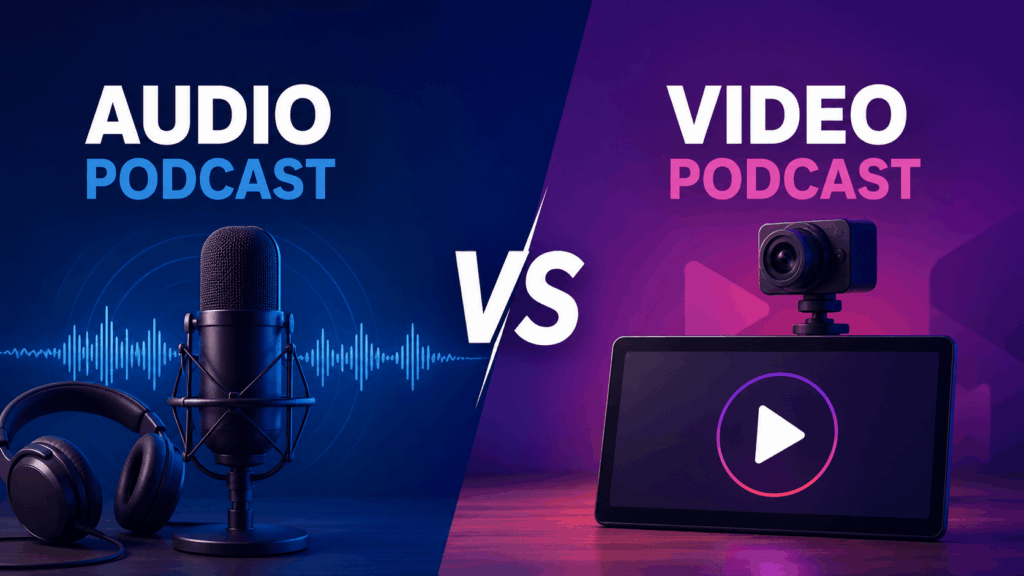
Audio Podcast vs Video Podcast: Which Is Better?
Podcasting has changed into more than just audio. Now experts can create the normal audio podcast or add video to their episodes, offering listeners the option to watch, listen, or do both.
Video podcasting has increased greatly in recent years. According to YouTube, in January 2025, more than 1 billion people were watching podcasting content monthly, and Edison Research’s survey of the year 2026 revealed that those who listen to podcasts also consume video podcasts.
So, the question still remains: is there a better option, an audio or video podcast? The answer depends on what content you have, your audience and budget, and your goal.
What Is an Audio Podcast?
An audio podcast is a podcast that is primarily disseminated in the form of audio recordings. Audiences are allowed to either stream the podcast episodes or download them and listen while doing activities such as traveling, doing housework, exercising, or even working.
An audio podcast is easier to create because the necessary equipment is very limited – creators will need microphones, source recording software, editing tools, and the hosting service for podcasts.
Benefits of Audio Podcasts
- Lower production cost: You do not need cameras, lighting, or a studio setup.
- Easier production: Recording and editing can be relatively straightforward.
- Convenient for listeners: Audiences can listen while multitasking.
- Less equipment: A good microphone and recording setup may be enough.
- Focus on conversation: The absence of visuals can make listeners concentrate on the discussion.
What Is a Video Podcast?
The notion of a video podcast is a mix between a conventional podcast and visual aspects. It may also show presenters and guests appearing in a studio as well as visual elements such as interviews, graphics, and demonstrations.
Video podcasts are becoming more and more popular on platforms like YouTube and Spotify. For example, YouTube had reported more than 1 billion podcast viewers per month as of January 2025, whereas Spotify stated that more than 500 million users streamed a video podcast in 2026.
Benefits of Video Podcasts
- Higher visual engagement: Viewers can see hosts, guests, expressions, and reactions.
- More discoverability: Video allows creators to use thumbnails, clips, Shorts, and other visual content.
- Stronger connection: Facial expressions and body language can make conversations feel more personal.
- Multiple content formats: A single episode can produce full-length videos, short clips, social posts, and promotional content.
- More monetization opportunities: Platforms increasingly provide tools for creators to monetize video podcast content.
Also Read: How to Start a Podcast
Audio Podcast vs Video Podcast: Quick Comparison
| Feature | Audio Podcast | Video Podcast |
|---|---|---|
| Production Cost | Lower | Higher |
| Equipment | Microphone and recording setup | Microphone, camera, lighting and more |
| Editing | Generally easier | More time-consuming |
| Audience Engagement | Good | Higher due to visuals |
| Multitasking | Excellent | More limited |
| Social Media Clips | Limited | Excellent |
| YouTube Potential | Limited | Strong |
| Production Complexity | Low | Medium to High |
| Visual Storytelling | No | Yes |
| Best for Beginners | Yes | Depends on Resources |
Can You Create Both Audio and Video Podcasts?
Absolutely. Creating both is really a good choice.
The same recording of video podcast can be used for the audio version. Besides, the longer episodes can also be divided into short clips suitable for platforms like YouTube Shorts, Instagram and so on.
In this way the creators can satisfy those who want to watch a video and those who would just like to listen to it.
This flexibility was in the focus of Spotify that lets people choose between watching and listening.
Should You Start With Audio or Video?
Choose audio podcasting if:
- You have a limited budget.
- You are completely new to podcasting.
- Your content is primarily conversation or storytelling.
- You want a simple production process.
- Your audience mainly listens while multitasking.
Also Read: Video Editing Tips That Increase Watch Time and Engagement
Choose video podcasting if:
- You want to grow on YouTube.
- Your content benefits from facial expressions or demonstrations.
- You want to create short-form video clips.
- You have access to suitable cameras and lighting.
- Audience growth and visual engagement are major goals.
Final Thoughts
There’s no one format that works best for every type of podcast. Audio podcasts are easier and cheaper to produce than video podcasts, while video content can provide more visual stimulation and present more ways to expose and use the content.
For someone just starting, producing an audio podcast is a great way to learn the basics. But if the goal is to develop a bigger multimedia presence, adding video will open more opportunities for audiences on platforms like YouTube and Spotify.
In the end, the best thing to do is to record once and publish in both formats.